
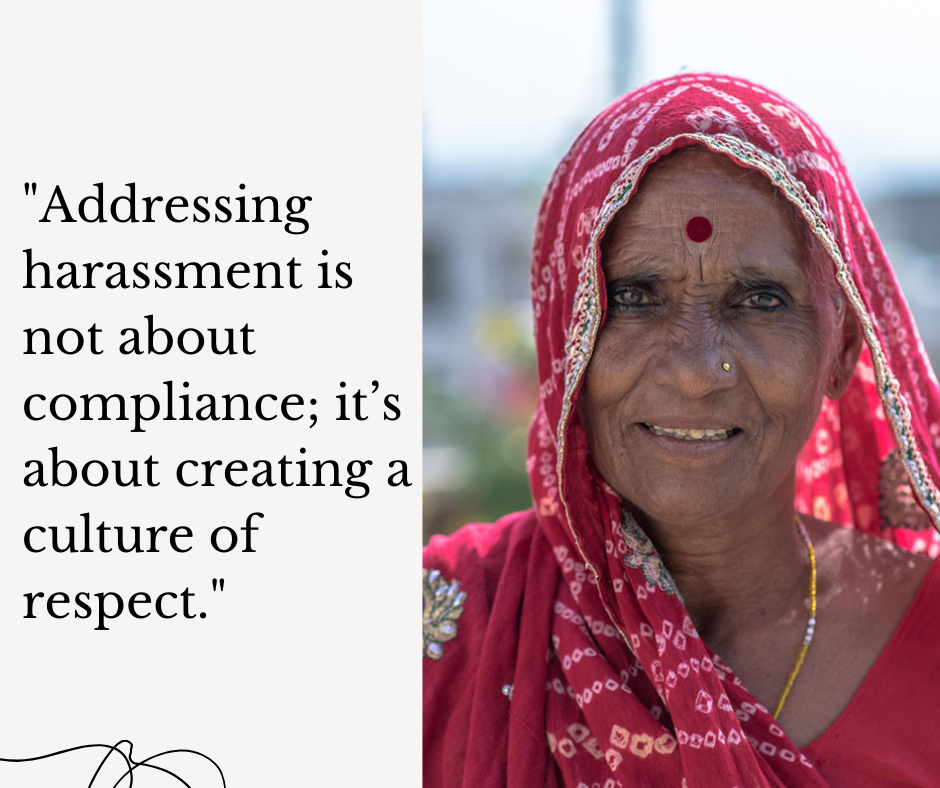
The POSH Act, 2013, safeguards women from sexual harassment at the workplace, ensuring a safe and equitable environment. Rooted in Bhawri Devi’s courageous fight for justice, it addresses systemic issues of gender, caste, and power, providing a legal framework to protect women’s dignity and empower them across diverse workplaces in India.
The Case
In the small village of Bhateri in Rajasthan, India, a woman named Bhawri Devi worked as a sathin (social worker) under the Women’s Development Program. Her role was to advocate for women’s rights, challenge harmful traditions, and promote gender equality in her community. Little did she know that her courage would ignite a movement leading to one of India’s landmark laws against sexual harassment at the workplace.
Bhawri Devi’s Mission
Bhawri Devi’s work was challenging from the start. The deeply patriarchal society she lived in resisted any efforts to change traditional norms, especially those that gave women fewer rights. In 1992, her duties brought her face-to-face with a troubling case: a nine-month-old girl was being forcibly married off.
Child marriage was a common practice in her village, but Bhawri, committed to protecting children and empowering women, raised her voice against it. She reported the case to local authorities, believing that her efforts could prevent the marriage and save the girl’s future.
The Attack
Bhawri’s actions enraged the upper-caste men involved in the marriage. They saw her interference not just as a challenge to their authority but also as an insult to their societal standing. On the night of September 22, 1992, Bhawri Devi faced the consequences of her courage in the most horrifying way.
While she was working in the fields with her husband, five men—members of the influential Gujjar caste—attacked the couple. They brutally beat Bhawri’s husband and then took turns raping her. The incident left Bhawri traumatized, humiliated, and in immense pain, but she refused to stay silent.
The Fight for Justice
Bhawri Devi sought justice, despite knowing how difficult it would be. In rural Rajasthan, caste dynamics heavily influenced the justice system. Women, especially from lower castes like Bhawri’s, rarely received fair treatment. Filing a case against powerful upper-caste men was unheard of, but Bhawri was determined.
Her case went to trial, but the legal process exposed the deep flaws in India’s judicial system. The trial court dismissed her claims, citing prejudiced reasons such as:
- The accused were from a “higher caste” and thus unlikely to rape a “lower-caste” woman.
- Bhawri’s husband could not have been a “silent spectator” during the assault.
- It was deemed “improbable” that upper-caste men would commit such a crime in a public space.
The verdict outraged activists, feminists, and human rights groups across India. They rallied around Bhawri Devi, condemning the court’s casteist and sexist reasoning.
The Vishaka Movement
Bhawri Devi’s case sparked a larger conversation about the safety and dignity of women in India, particularly in workplaces. Her assault, though occurring in an agricultural field, was tied to her role as a social worker. It became clear that women across sectors—whether working in offices, factories, or farms—faced harassment and violence, often with little to no recourse.
A group of women’s rights organizations, including Vishaka, filed a Public Interest Litigation (PIL) in the Supreme Court of India. They demanded legal protections for women against sexual harassment in workplaces, using Bhawri Devi’s case as a prime example of systemic failure.
The Vishaka Guidelines
In 1997, the Supreme Court delivered a landmark judgment known as the Vishaka Guidelines. These guidelines established:
- A clear definition of sexual harassment, including unwelcome physical contact, demands for sexual favors, sexually colored remarks, and any other unwelcome behavior of a sexual nature.
- The employer’s responsibility to provide a safe working environment for women.
- The requirement for organizations to set up Internal Complaints Committees (ICCs) to address grievances related to sexual harassment.
The Vishaka Guidelines served as the first legal framework in India to combat workplace harassment, filling a critical gap until formal legislation could be enacted.
The POSH Act, 2013
Bhawri Devi’s courage and the activism it inspired eventually led to the enactment of the Sexual Harassment of Women at Workplace (Prevention, Prohibition and Redressal) Act, 2013—commonly known as the POSH Act. This law made it mandatory for all organizations in India to:
- Create awareness about workplace harassment.
- Set up ICCs to investigate complaints.
- Ensure timely action and resolution of cases.
The POSH Act expanded on the principles of the Vishaka Guidelines, offering a comprehensive legal structure to protect women at work. It also recognized that harassment is not limited to physical offices and includes virtual or digital spaces.
Bhawri Devi’s Legacy
Despite the systemic failures she faced, Bhawri Devi became a symbol of resilience. Her fight brought attention to the intersection of gender, caste, and power, highlighting the unique struggles of marginalized women. While her personal battle for justice remains unresolved, her story catalyzed a movement that transformed India’s approach to workplace safety and gender equality.
Bhawri Devi continues to inspire millions of women to stand up against injustice. The POSH Act is not just a legal safeguard but a tribute to her bravery and the countless women who have fought for their right to live and work with dignity.